

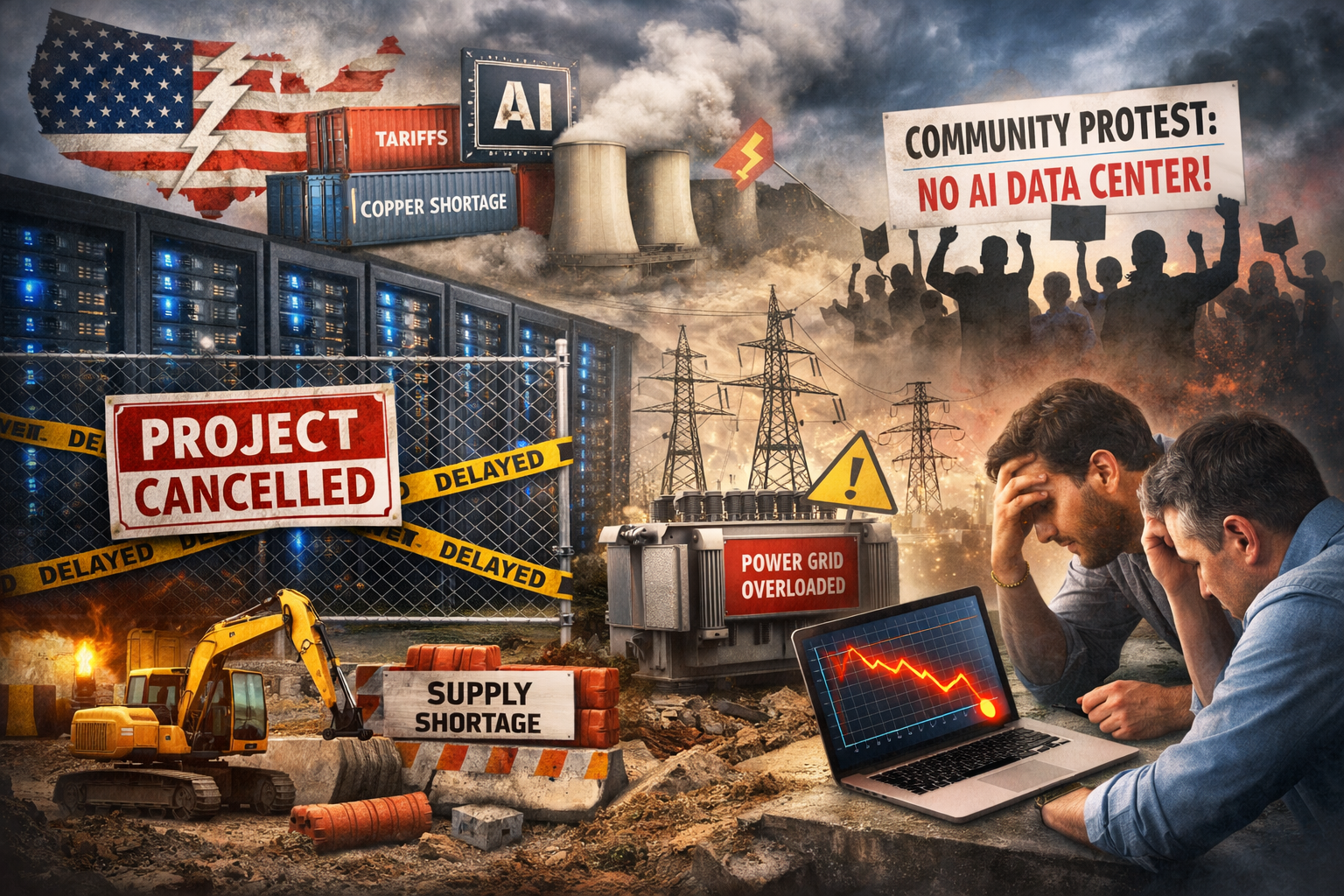
For the past year and a half, AI has felt unstoppable. New data centres were popping up everywhere. Bigger facilities. Bigger investments. Bigger promises.
But now? Things are getting messy.
Across the US, a growing number of planned data centres are being delayed or quietly scrapped. According to research from MacroEdge and reporting from Heatmap, 26 projects were cancelled through January. Back in October, there was just one. That’s not a tiny fluctuation. That’s a warning sign. And it’s raising a bigger question: Can the US actually build the infrastructure needed to keep this AI boom alive?
It’s Not Just One Problem. It’s a Pile-Up.
This isn’t about one bad policy or one supply hiccup. It’s everything at once. Energy shortages. Equipment stuck in supply chains. Tariffs pushing up costs. Local communities protesting massive power-hungry facilities in their backyard. And in the background? Investors quietly wondering if we’re in an AI bubble.
MacroEdge’s chief economist, Don Johnson, didn’t sugar coat it. He suggested that if data centre growth slows, the administration may have to search for a new engine of economic growth. Data centres have been a major tailwind for the US economy recently. If that wind dies down… well, you can guess what happens next.
These Centres Use a Massive Amount of Power
Let’s pause on something important. These hyper-scale data centres don’t sip electricity. They gulp it. Some consume as much power as entire US cities. That means grids need serious upgrades — new transformers, high-voltage cables, steel poles, circuit breakers. It’s not just flipping a switch. And connecting to the grid? That’s becoming the biggest headache. Marsden Hanna, Google’s head of energy and sustainability, said it plainly at a recent industry event: grid connection is their number one challenge. Utilities in some regions are quoting four to ten years just to connect projects. One utility reportedly told Google it would take 12 years just to study the interconnection timeline.
The Grid Was Already Struggling
Douglas Jester from 5 Lakes Energy pointed out something that often gets overlooked — the system was already slow before AI demand exploded. No federal agency tracks data centre proposals in a clean, organized way. Developers often pitch the same project in multiple states, then move forward wherever they get the best deal and fastest timeline. So cancellations can look dramatic, but sometimes it’s strategic reshuffling. Still, the core issue remains: many grids simply don’t have enough power ready to go. And adding new power isn’t quick. Regional grid operators can take up to five years to review how a new gas plant or solar farm might affect stability. That process existed to protect reliability. But now it’s clogged. It’s like adding more cars to a highway that was already jammed.
Clean Energy Complicates Things Further
There’s another layer to this. Transitioning to clean energy takes time. Solar installations, for example, often require several sites to match the output of a single gas plant. More installations mean more reviews. More paperwork. More delays. The clean energy shift was already facing bottlenecks. Then AI came knocking, asking for city-sized power loads.
It’s a lot. Texas, interestingly, does things differently. Its grid operator, ERCOT, moves faster and deals with problems later if they arise. Riskier, maybe. But quicker. Other regions tend to move cautiously — which means longer waits.
Supply Chains Are Still a Mess
If energy delays weren’t enough, supply chains aren’t cooperating either. Demand for transformers has surged. Lead times that used to be six months now stretch up to four years in some cases. Only one US plant produces a specific type of steel used in many grid components. Copper shortages aren’t helping. Skilled labour? Also tight. And then there are tariffs. The US utility industry relies heavily on imported infrastructure components, particularly from China. But global demand has increased, and tariffs have made the US market more expensive for foreign suppliers. Transformer prices are reportedly up to six times higher than they were before 2022. That’s not a small bump. That’s painful.
Investors Are Getting Nervous
When infrastructure slows, money starts to hesitate. Some hedge funds and institutional investors are growing cautious about heavy data centre exposure. Blue Owl recently stepped back from a $10 billion investment tied to a controversial Michigan project. Oracle says it’s moving forward, but there’s noticeable hesitation in the broader investment community.Johnson warned that these delays should give investors pause.Because if projects can’t get connected until 2030 — as PJM, the largest US grid operator, has suggested in some cases — returns won’t come quickly.
And investors don’t love waiting.
Are There Solutions? Maybe.
It’s not all doom and gloom. Steel manufacturers are ramping up production. Battery storage is becoming a serious option. Instead of constantly building new power plants, large-scale batteries can store excess energy and release it when needed. That could ease some pressure on the grid. Oracle has proposed using battery storage to help power its planned 1.4-gigawatt data centre in Michigan — a facility that would consume as much power as Detroit. But even that depends on cooperation from local utilities like DTE Energy, which is already near capacity.
Meanwhile, big tech companies are experimenting with new transformer designs that require fewer scarce materials. Early days, sure. But promising.
So Where Does This Leave the AI Boom?
The AI wave isn’t crashing. Not yet. But the physical world — steel, copper, wires, power plants, permits — is reminding everyone that digital growth still runs on very real infrastructure. And that infrastructure takes time.Maybe this is just a temporary bottleneck. Maybe innovation catches up. Or maybe growth slows enough to force a reset.
Hard to say.
But here’s something to think about: AI may be virtual, but the power behind it is anything but. And right now, the US grid is feeling the strain.