

In a recent CNBC interview, Morgan Stanley strategist Mike Wilson summed up the current stock market situation in just two words: “stealth correction.”
And honestly, that description might be more accurate than it first sounds.
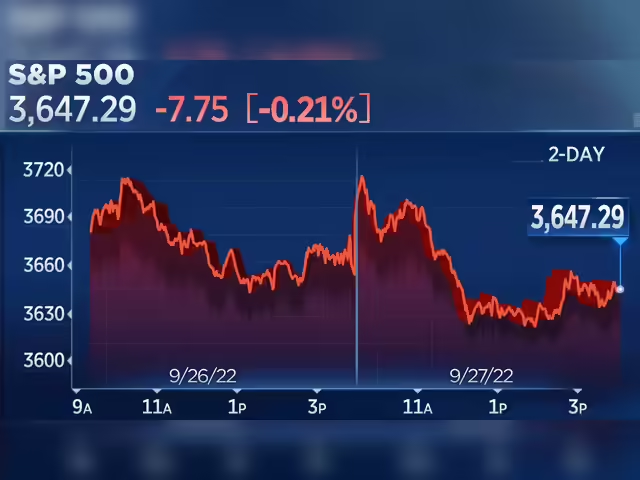
At a glance, the S&P 500 doesn’t look like it’s in trouble. The index has been hovering near record levels and moving within a relatively tight range. Nothing dramatic. Nothing that screams “market correction.”
But Wilson argues the real story is happening under the surface.
The Index Looks Calm — But the Market Isn’t
Let’s rewind a bit.
Back on Feb. 12, 2026, the S&P 500 was trading around 6,941.47, close to all-time highs according to Yahoo Finance.
Fast forward to Feb. 27, and the index closed at 6,878.88. That’s down about 62 points, roughly a 1% drop.
On paper, that’s not much.
Over the past three months the index has mostly moved sideways. Since Dec. 1, 2025, when it sat at 6,812, the market has gained only about 1%.
Pretty uneventful, right?
Not exactly.
The pattern in January and February has been a bit like a see-saw. The index keeps sliding toward 6,800, then bouncing back toward 6,950 or higher. Over and over again.
Wilson calls this dispersion. And it’s a big deal.
The Huge Gap Between Winners and Losers
Here’s where things get interesting.
Even though the S&P 500 looks stable, individual stocks tell a very different story.
The gap between the top 50 stocks and the bottom 50 stocks in the index has reached 68% so far this year. That’s the largest spread in two decades.
Let’s break that down.
- Top 50 stocks: up about 18% this year
- Bottom 50 stocks: down about 50%
That’s a massive divide.
So while the index looks calm, many companies have already taken serious hits — some dropping 20%, 30%, or even more.
In other words, the correction may already be happening… just quietly.
Tech Giants and AI Spending Are Shifting the Market
Some analysts think the reason for this split lies in the tech sector, especially companies leading the AI boom.
Bank of America strategist Michael Hartnett recently pointed out that the dominance of mega-cap tech stocks might be starting to crack. Large cloud companies and hyper scalers are pouring huge amounts of money into AI infrastructure, which is putting pressure on profits. At the same time, Morgan Stanley analyst Katie Huberty says investors have been selling AI stocks almost indiscriminately.
Basically, some investors are hitting the sell button first and asking questions later.
That kind of behaviour creates exactly the kind of hidden market damage Wilson is talking about.
Wall Street Still Sees Higher Prices Ahead
Despite all this volatility, most major banks are still optimistic about the S&P 500 over the longer term.
Here are some of the current forecasts for year-end 2026:
- Morgan Stanley: 7,800
- Deutsche Bank: 8,000
- J.P. Morgan: 7,500
- Barclays: 7,400
- Bank of America: 7,100
For context, the index closed Feb. 27 at 6,878.88.
So Morgan Stanley’s target alone suggests about 13% upside from current levels.
Not bad.
But and this is important Wilson believes the market might still need to shake out some excesses first.
The Market’s “Fear Gauge” Isn’t Showing Panic
Here’s another strange piece of the puzzle.
The VIX, often called the market’s fear gauge, closed around 19.86 on Feb. 27. That’s actually a fairly calm level.
So according to the VIX, the market isn’t overly nervous.
But another measure tells a different story.
The VIXEQ, which tracks volatility across the average S&P 500 stock, was around 40.98 — roughly double the VIX.
What does that mean?
Simple, individual stocks are swinging wildly, even though the overall index looks steady.
It’s like the ocean surface looks smooth… while big waves are crashing underneath.
Wilson Thinks the Correction Is Almost Over
Here’s the surprising part.
Wilson believes the market correction may already be 70% to 80% finished.
His reasoning is straightforward: many individual stocks have already taken the hit. The “average” stock has corrected even if the headline index hasn’t. The big question now is whether the largest stocks — the ones holding up the index — will eventually pull back as well. If they do, the S&P 500 could briefly “catch down” to the weakness already seen across the rest of the market.
So What Should Investors Do?
Wilson isn’t bearish overall. Not even close.
He still expects the market to move higher later this year — especially if corporate earnings keep beating expectations.
But he’s also realistic about the near term.
Some turbulence is probably unavoidable.
His advice? Be selective.Investors might want to look at beaten-down stocks where fundamentals are stabilizing — companies where earnings estimates have stopped falling, margins remain steady, and valuations already reflect most of the bad news.
That said, not every cheap stock is a bargain.
Some companies are struggling for real reasons: weak demand, heavy debt, or intense competition.
Those aren’t automatic comeback stories.
A Balanced Approach Might Be the Smart Move
Wilson emphasizes something many investors forget during volatile markets: position sizing matters.
Instead of going all-in on one idea, it’s often smarter to scale into positions gradually.
Think of it as building exposure piece by piece rather than making a single big bet.
He also suggests maintaining a mix of defensive stocks while selectively adding cyclical or overlooked companies that could rebound as fundamentals improve.
Not flashy. But disciplined.
And in markets like this, discipline usually wins.