

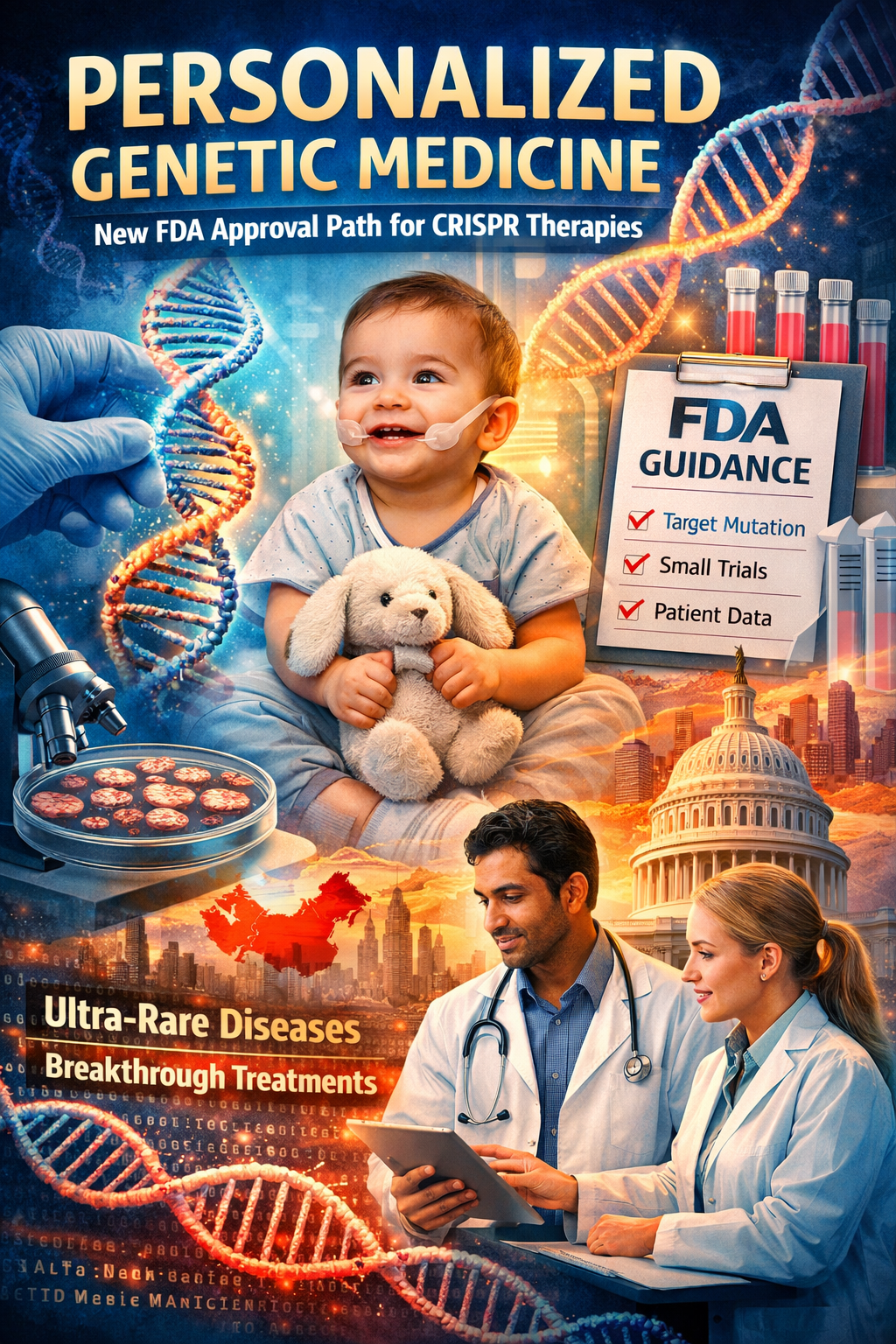
The FDA is finally putting real structure behind something that, not long ago, sounded futuristic — fully personalized genetic treatments.
After hinting late last year that changes were coming, the agency has now released draft guidance for a new approval pathway. The goal? Make it possible for highly customized CRISPR therapies — like the one used to treat critically ill baby KJ — to move through the system more smoothly.
For now, the focus is on genome editing and RNA-based treatments, including antisense therapies. These aren’t band-aid solutions. They aim straight at the genetic root of rare diseases.
That’s a meaningful shift.
The “Plausible Mechanism” Framework
FDA Commissioner Marty Makary and Vinay Prasad from the Center for Biologics Evaluation and Research first introduced this idea last November in The New England Journal of Medicine. They call it the “plausible mechanism” framework.
Here’s the deal: rare diseases don’t always allow for massive, traditional clinical trials. Sometimes there just aren’t enough patients.
Under this new approach, if scientists can clearly identify the biological cause of a disease — and show that a therapy directly targets that mechanism — approvals might be possible based on smaller datasets. In some cases, data from just a handful of patients could support broader use.
Prasad even described it as a “revolutionary advance” in regulatory science.
Fewer Trials for the Same Gene
Robert F. Kennedy Jr., speaking at a press conference, put it bluntly: if one gene has 100 different mutations, we shouldn’t need 100 separate trials. If the biology is clear and the science is sound, regulators shouldn’t block progress with what he called “arbitrary barriers.”
Let’s be honest — for families facing ultra-rare diseases, waiting years for massive studies isn’t realistic.This pathway is trying to address that tension.
What Companies Still Have to Prove
This isn’t a free pass, though.
Developers must meet several conditions. First, they have to clearly identify the underlying biological cause of the disease. Then they must show that the therapy directly targets that root mechanism — not just symptoms, but the actual genetic or molecular driver. They can also use well-documented “natural history” data from untreated patients as a comparison group. That’s important in rare diseases where randomized control groups are hard to build Clinical trials still need to show real benefits — symptom improvement, slowed disease progression, fewer severe episodes. Biomarkers may count too, but only if they reliably predict meaningful clinical outcomes. And the FDA says results must be strong enough to rule out random chance. Rare disease trials are small, yes. But the evidence bar remains high.
Baby KJ: The Example That Sparked It
When regulators first discussed this pathway, they pointed to baby KJ. KJ had CPS1 deficiency, a rare and life-threatening disorder. His personalized CRISPR therapy targeted a specific mutation known as Q335X. Researchers already understood the disease’s natural history. They also showed in preclinical work that the therapy edited 42% of liver cells in mice. That groundwork mattered. Now, the team behind KJ’s treatment says they’re thinking bigger. Instead of one-off therapies, they’re building a platform. The hope is to launch a single clinical trial covering multiple liver-based disorders, including other urea cycle diseases.
It’s not just one child anymore. It’s a model.
Post-Approval Isn’t the End
Even if a product gets approved under this framework, the FDA says oversight won’t stop there.The agency will continue collecting safety and effectiveness data after launch. If follow-up studies reveal problems, the FDA can pull the therapy from the market.One senior official emphasized that each case will be handled individually. The hope, they said, is to unlock treatments for ultra-rare diseases that otherwise would never see an approved option.They’re even expecting a wave of applications.
Reality Check: Recent Rejections
Still, there’s some tension here.
Gene therapy developers have had a rough stretch. The FDA recently told uniQure that its Huntington’s disease gene therapy didn’t have enough evidence for approval. Regenxbio’s Hunter syndrome therapy was also rejected, partly due to concerns about natural history controls and biomarker endpoints — tools that, on paper, the new framework appears to support.When asked about the apparent contradiction, FDA officials declined to comment on specific cases. They stressed that the standards for evidence aren’t changing.The pathway may be new. The bar remains high.It’s a bit of a balancing act. Speed versus certainty. Innovation versus safety. Like a see-saw that regulators are trying to keep level.
Calls for Clarity and Transparency
Rebecca Ahrens-Nicklas, one of KJ’s physicians, made an important point: consistent and transparent guidance is essential if this field is going to grow.She called for “radical transparency” — sharing both wins and setbacks as gene-editing therapies move forward.That honesty might matter as much as the science.
Competition With China
There’s also a geopolitical layer.
Some worry that the U.S. is falling behind China in gene therapy innovation. China has been streamlining its regulatory processes, accelerating reviews for advanced therapies. If the U.S. system moves too slowly, innovation could shift overseas.FDA officials acknowledged that one guidance document won’t solve everything. More reforms may be needed. But this pathway signals that the U.S. wants to stay competitive.They want leadership in rare diseases. And beyond.
The Bottom Line
Personalized CRISPR therapies aren’t science fiction anymore.The FDA’s new “plausible mechanism” pathway won’t magically solve every regulatory challenge. It won’t lower the bar for evidence either. But it does open a door — especially for patients with ultra-rare conditions who’ve had few, if any, options.It’s cautious progress. Not a revolution overnight.Still, for families waiting on treatments that don’t yet exist, even cautious progress can feel like hope.