
Elon Musk is thinking… bigger. Again.
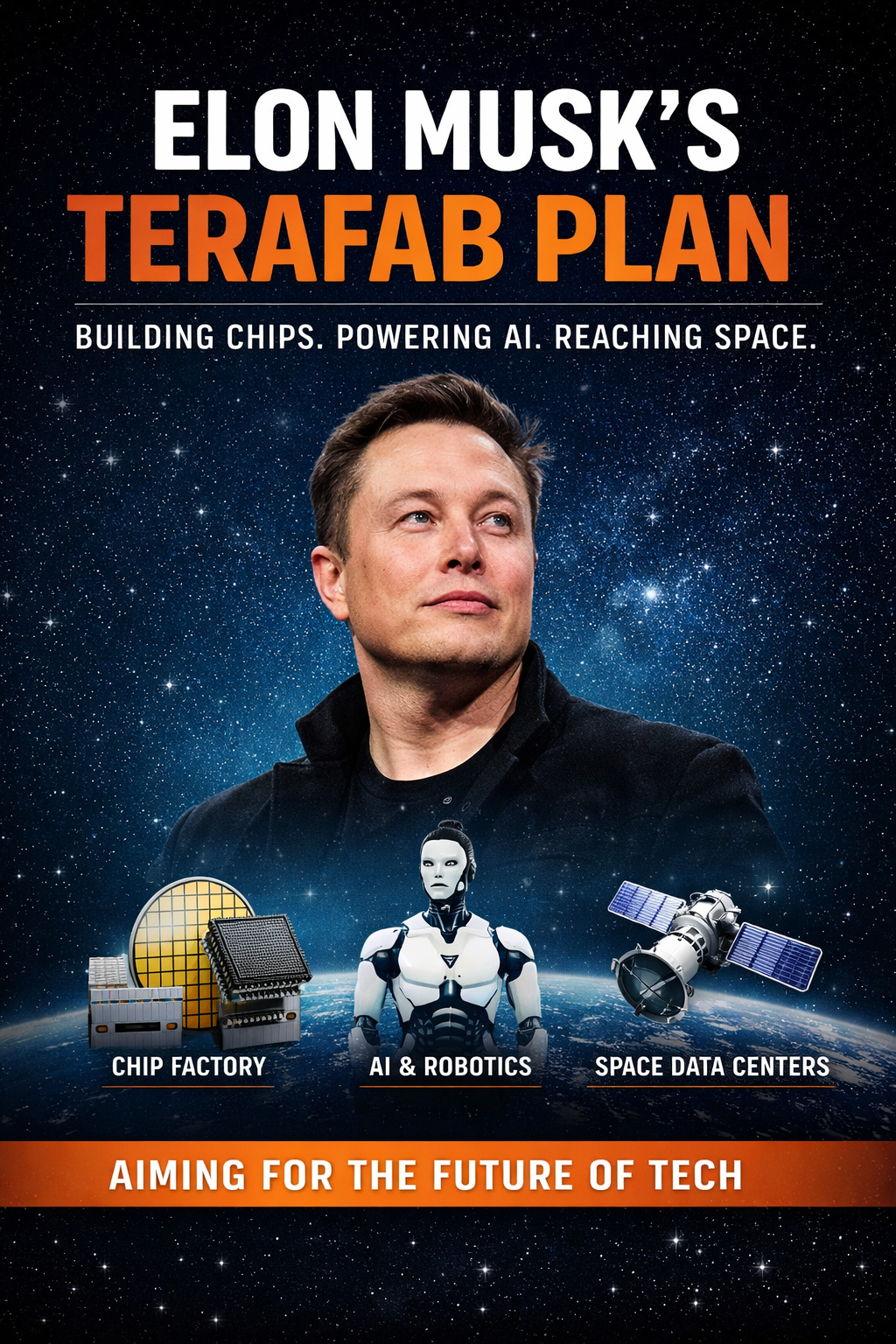
This time, it’s not just about cars or rockets. He’s planning to build his own chip manufacturing facility something he’s calling the “Terafab.” And yes, it’s as ambitious as it sounds.
The plan? Set it up in Austin, Texas. It’ll be run jointly by Tesla and SpaceX. Musk says the first step is an “advanced technology fab” basically a facility that can design, build, and test chips all under one roof.
No outsourcing. No waiting.
Why Build Chips In-House?
Musk doesn’t trust the current chip supply to keep up.
He’s been pretty vocal about it. According to him, the semiconductor industry just isn’t moving fast enough to match the explosion in demand from AI, robotics, and autonomous systems. And honestly, he’s got a point.
So his approach is simple:
If you can’t get enough chips… build your own.
“We either build the Terafab or we don’t have the chips,” he said. Straight to the point.
The Scale? It’s Huge
Musk isn’t thinking small here.
He says the long-term goal is to support a terawatt of computing power per year. That’s massive. Almost hard to wrap your head around. In the near term, he’s talking about chips that can handle 100 to 200 gigawatts annually on Earth, and eventually scaling up to a terawatt — especially for space-based computing. No timelines, though. Which, let’s be honest, is very Musk.
But There’s a Catch…
Musk doesn’t exactly have a background in semiconductor manufacturing and building chip fabs? It’s not like launching a new app. These facilities cost tens of billions of dollars, take years to build, and rely on extremely complex equipment from multiple suppliers.
It’s a slow, expensive process.
So yeah, ambitious. But also risky.
What Kind of Chips Are We Talking About?
The plan includes two main types:
- Edge and inference chips — these would power Tesla’s vehicles, robotaxis, and even Optimus humanoid robots
- High-performance chips for space — designed for SpaceX and xAI, especially for heavy AI workloads
Musk expects xAI to use most of these chips. Which makes sense, given how aggressively he’s pushing into AI.
Space Data Centres? Yes, Really
Now here’s where it gets… very Musk. He also revealed a concept for mini AI data centre satellites. Basically, floating computing hubs in space. The first version would handle around 100 kilowatts of power, but future versions could reach megawatt levels.
And it doesn’t stop there.
SpaceX has already requested permission to launch up to one million data centre satellites into orbit. One million.
Let that sink in.
The Bigger Vision (Because Of Course There Is One)
Musk isn’t just thinking about Earth.
He even talked about launching satellites from the moon using something called a “mass driver.” Think of it like a giant slingshot on the lunar surface.
Sounds wild. Because it is. But in Musk’s world, that’s just part of a future filled with what he calls “abundance.”
Money, Partnerships, and AI Expansion
This whole push ties into a bigger ecosystem.
Tesla, SpaceX, and xAI are becoming more interconnected:
- Tesla is already working with xAI on projects like Digital Optimus
- Tesla has invested $2 billion into xAI
- Grok (xAI’s chatbot) is now integrated into some Tesla vehicles
- Tesla even supplies energy storage (Megapacks) to xAI
SpaceX’s upcoming IPO which could raise up to $50 billion is also expected to help fund these massive plans.
The Reality Check
Let’s be real for a second.
Building a chip fab from scratch is one of the hardest things in tech. Even giants struggle with it. And Musk has a history of… optimistic timelines. At the same time, demand for AI chips is exploding. Companies like TSMC, Samsung, and Micron are already stretched. So Musk stepping in? Not entirely surprising.
The Bottom Line
This isn’t just about chips.
It’s about control. Speed. Scale.
Musk wants to own the entire stack from AI models to hardware to space infrastructure. It’s like building a vertical empire for the AI age.
Will it work?
Hard to say.
But if there’s one thing we know when Musk bets big, it’s never boring.